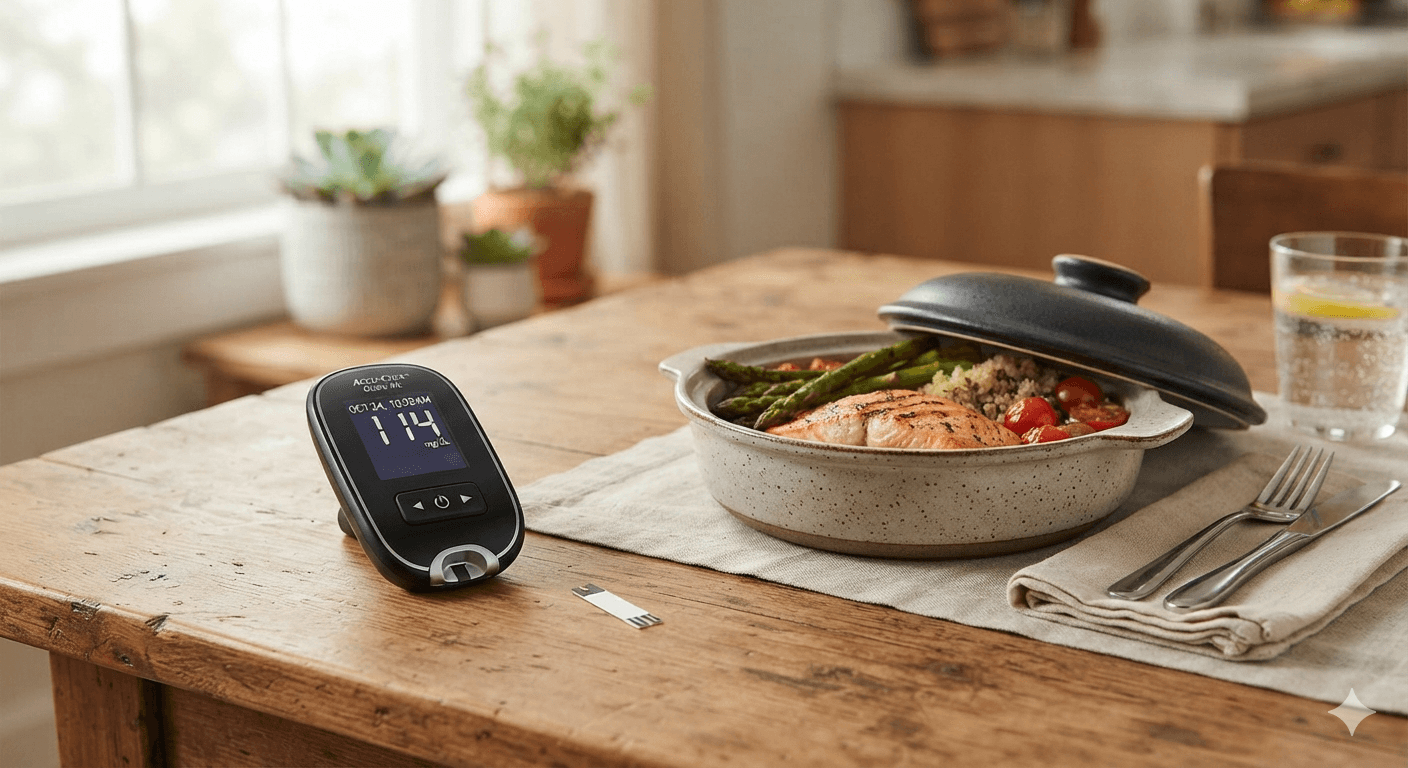
You ate your meal.
You waited.
You checked your blood sugar.
Then you saw a number that scared you.
First, don't panic.
Your blood sugar is expected to rise after eating. It happens to everyone, including people without diabetes.
The difference is that if you have diabetes, it may rise higher or stay high for longer.
So one high reading doesn't mean you've failed. It doesn't even tell the whole story.
The better questions are:
How high did it go?
How long did it stay there?
What exactly did you eat with the meal?
Those three questions usually explain the number you're seeing.
How high should your blood sugar be after eating?
Here's something many people don't know.
If you have type 2 diabetes, there isn't one official after-meal target for everyone.
According to Diabetes UK, NICE doesn't set a universal target. Instead, your healthcare team should agree on one that's right for you.
For adults living with type 1 diabetes, the same guidance recommends 5 to 9 mmol/L, checked at least 90 minutes after eating.
That's important because many people spend months searching online for the "perfect" after-meal number when there isn't a single one.
Ask your doctor or diabetes nurse what your own target should be.
Your blood sugar reading only means something when you know what you're comparing it to.
How long should your blood sugar stay high?
After you eat, your blood sugar usually starts rising within minutes.
For most people, it reaches its highest point around one hour after eating before gradually coming back down over the next hour or two.
That's why checking immediately after eating isn't very helpful.
A reading taken 30 minutes after a meal is simply catching your blood sugar on its way up.
If your blood sugar is still high three hours later, speak with your healthcare team.
Food may be the reason, but medication, illness, stress, or timing can also play a role.

Why is it still high even though you ate carefully?
This is where many people get confused.
Not all meals behave the same way.
The food you eat with your starch matters.
For example, boiled yam eaten alone has a glycaemic index of 94.
Add a fried egg, and it drops to 84.
Just one egg made a noticeable difference.
Now compare that with unripe plantain.
On its own, it scores 89.
With stew, it becomes 88.
Only a one-point difference.
So telling someone to "eat it with something" isn't enough.
What you eat with it matters.
The quantity matters too.
Half a cup of rice isn't the same as a large serving of rice, even if they're both the same type of rice.
The same goes for swallow.
Soup can help slow down how quickly your blood sugar rises, but it doesn't cancel out a very large portion.
So whenever a reading surprises you, don't just ask what you ate.
Also ask:
How much starch was on the plate?
What did you eat with it?
How long has it been since you last ate that same meal?
What can you do in the two hours after eating?
The meal is over, but there's still something you can do.
One of the simplest things is to walk.
Research found that walking for 10 minutes after each main meal lowered after-meal blood sugar more than taking one 30-minute walk at another time of the day in adults living with type 2 diabetes.
It doesn't have to be exercise.
Walk around your compound.
Walk to the junction and back.
Stand up and wash the dishes instead of sitting down immediately.
Drink water.
Avoid sugary drinks.
And don't skip your next meal because of one high reading.
That usually creates another problem instead of solving the first one.
When should you be concerned?
One high reading after a heavy meal isn't enough to draw conclusions.
But if the same meal keeps giving you high readings again and again, that's a pattern.
Write down:
Your blood sugar reading.
What you ate.
How the food was prepared.
Then take that record to your healthcare team.
If you also have high blood pressure or kidney disease, mention that too.
Those conditions can change what's best for you.
The reading is decided before you eat
Most people only check their blood sugar after eating.
But by then, the decision has already been made.
The portion you served.
What you paired it with.
How often you eat it.
Those are the things that shape the number you'll see later.
That's exactly what GluFloat helps you with.
Search any Nigerian meal, and it tells you how much to eat, what to eat it with, and how often to eat it before your meal, not after.
Because the best blood sugar reading is usually decided before the first bite.
Check your food before you eat it.
Search from 1,500+ Nigerian foods and meals to instantly see whether it's green, yellow, or red for your diabetes and discover simple changes that can turn it into a better choice.
Start my 7-day free trialFree for 7 days. No card required.
Read next
- Is Fufu Good for Diabetes? Cassava, Wheat and Plantain FufuIs fufu good for diabetes? Fufu scored 97, the highest swallow measured in Nigeria. See the safe size, the best soup, and how wheat and plantain fufu compare.8 min read
- Is Garri Good for Diabetes? Eba, Soaked Garri, Ijebu and Yellow GarriIs garri good for diabetes? See how eba and soaked garri differ, whether ijebu or yellow garri is safer, and the best way to take garri with diabetes.6 min read
- Which Nigerian Foods Raise Blood Sugar the Most? What People With Diabetes Should KnowWhich Nigerian foods raise blood sugar the most? See the glycemic index of eba, fufu, pounded yam, rice and beans, and which foods raise it slowly.4 min read